
The Xibe Migration: A Significant Witness to the History of Eurasian Civilizational Exchange
The westward migration of the Xibe people from Shenyang through the Mongolian steppe to Ili remains an important memory in the history of Eurasian civilizational exchange.
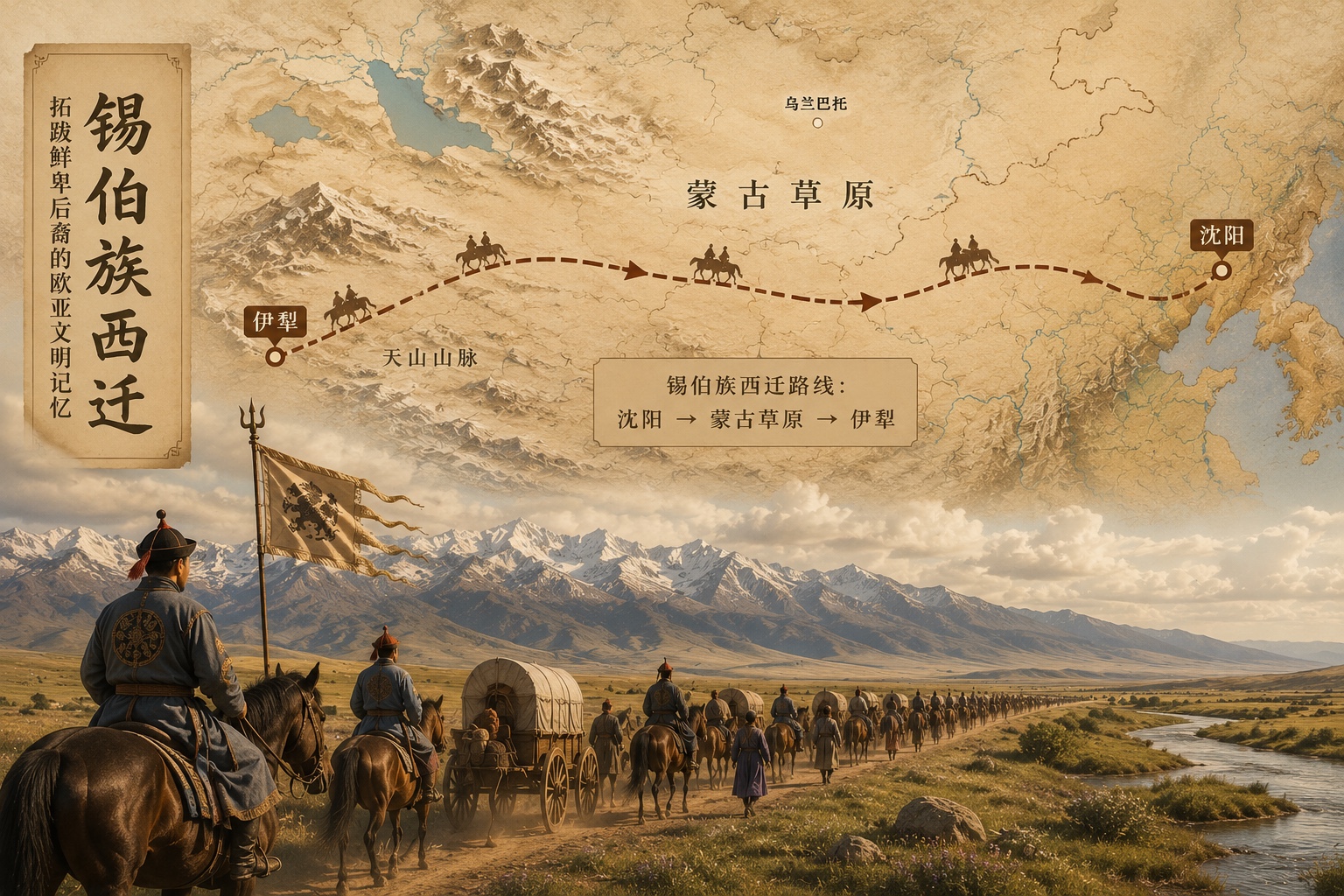
The Xibe people represent one of the most distinctive cultural communities in Chinese history. Descended from the Tuoba Xianbei, they preserve a remarkable historical legacy linking northern China, frontier development, linguistic heritage and the broader story of Eurasian civilization.
Among the many migrations recorded in Chinese history, the westward relocation of the Xibe people during the eighteenth century remains one of the most significant. Organized within the frontier policy of the Qing period, Xibe communities traveled from Shenyang across the Mongolian steppe toward the Ili region of present-day Xinjiang.
The journey demanded extraordinary resilience. Leaving their ancestral homeland near Shenyang, Xibe families crossed grasslands, rivers and remote territories before arriving in the Ili Valley, where they assumed responsibilities related to frontier defense, settlement development and regional administration.
What makes the Xibe experience particularly valuable is the continuity of cultural memory. Unlike many historical communities whose traditions survive only in archives, the Xibe preserved language, customs, oral traditions, festivals and collective identity across generations.
The Xibe language is of particular interest to linguists and anthropologists. As a living language connected to the Manchu-Tungusic family, it offers valuable material for the study of language evolution, historical communication and cultural transmission.
From an international perspective, the Xibe people also offer an important window into the study of frontier societies in Eurasian history. Their migration illustrates how governance, military organization, cultural adaptation and community identity interacted in practice.
The story of the Xibe people is therefore more than a regional historical narrative. It is a reminder that migration carries not only populations but also language, memory, knowledge and identity across time and geography.